
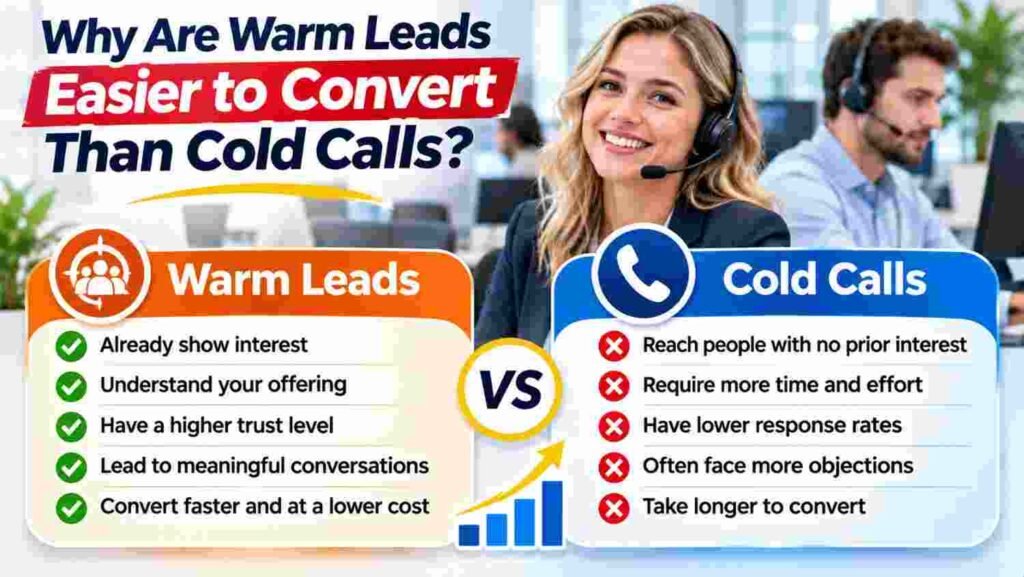
A salesperson who contacts someone after a relevant enquiry starts with a different opportunity from one who interrupts a stranger. The first prospect may already recognise the product, have a question or want a quotation. The second must first decide whether the conversation deserves attention. That difference often makes warm leads easier to convert than cold calls. Yet previous interest does not guarantee a sale. The quality of the enquiry, the timing of contact and the suitability of the offer still determine whether an initial conversation progresses.
What Separates a Warm Lead From a Cold Prospect?
A warm lead has shown some relevant interest before a salesperson approaches them. That interest might involve requesting a quotation, speaking with a representative or asking for product details. Cold calling generally begins without a current enquiry or established invitation to discuss the offer.
Not every interaction signals buying intent
Someone requesting a detailed insurance quotation usually provides stronger evidence of intent than someone clicking an advertisement. Similarly, an enquiry from several months earlier may reveal less about current needs than a recent request for a callback. Businesses should therefore evaluate the action behind each lead instead of labelling every previous website interaction as a promising opportunity.
A warm lead can still be unfamiliar with policy conditions, uncertain about affordability or unwilling to commit. Meanwhile, a person reached through lawful cold outreach might have an unmet need and welcome a relevant conversation. The distinction describes the starting relationship, not a guaranteed sales outcome.
Existing Interest Makes Conversations More Relevant
Previous engagement gives a representative a useful starting point. Rather than guessing what matters to the prospect, the salesperson can respond to a stated concern, coverage request or purchasing question. This can reduce the effort required to establish relevance.
Interest gives the representative context
Consider a prospect who asks about life cover for a family. An appropriate follow-up can examine the type of protection sought, affordability concerns and the next steps towards a quotation. In a cold call, the representative must first establish whether the recipient has any interest in life insurance at all.
However, interest has degrees. Someone comparing premiums may want to purchase soon, while another person may be gathering information for a decision months away. Good sales conversations distinguish curiosity from active consideration instead of treating every enquiry as permission to push for an application.
Relevant questions move decisions forward
Warm conversations may reach practical issues earlier: product features, exclusions, eligibility, costs and the documents required for a quotation. As a result, agents can identify whether further discussion would benefit the customer. They should still explain unfamiliar terms and check assumptions. Earlier contact does not mean a prospect knows every important condition.
Familiarity Can Reduce Resistance, but Trust Must Be Earned
An unexpected caller asks for attention before establishing why the recipient should listen. A prospect who requested contact may recognise the subject and anticipate the conversation. Familiarity can therefore remove an early obstacle, although it cannot establish credibility on its own.
Expectation changes the opening exchange
A representative who says why they are calling and refers accurately to a recent enquiry gives the prospect a clear reason to continue. Conversely, a cold caller may need to explain the business, the purpose of the approach and the relevance of the offer before discussing any specific need.
Yet poor follow-up can destroy the advantage of a warm lead. An irrelevant pitch, an unfamiliar caller claiming excessive prior knowledge or repeated calls outside an agreed window can create suspicion. Clear identification, honest explanations and respect for the prospect’s preferences matter more than a familiar opening line.
Handling objections without pressure
Cold prospects may object primarily to the interruption or lack of interest. Warm prospects may instead question price, coverage limits, suitability or timing. Representatives can address those concerns with accurate information, but they should never confuse a request for clarification with a commitment to purchase. Respectful responses preserve the option of a later conversation when a decision requires more time.
Contact Timing Influences Responsiveness
Interest can change between the original enquiry and the next conversation. A customer may obtain another quotation, rethink priorities or become busy. Prompt contact can preserve a useful opportunity, provided the timing matches what the prospect requested.
Speed should follow customer preference
Someone asking to speak immediately may welcome a direct connection. Another person who books an evening appointment might regard an immediate daytime call as intrusive. Consequently, effective teams distinguish urgent enquiries from agreed callbacks rather than imposing the same response schedule on every lead.
Follow-up processes should record when customers want contact and what they have already discussed. Where the first attempt fails, sensible spacing and an appropriate alternative channel can prevent needless repetition. However, teams must also respect relevant contact permissions and withdrawal requests.
Qualification Turns Interest Into a Useful Opportunity
A lead becomes commercially useful when the potential customer’s circumstances align with an offer the business can legitimately provide. Previous engagement supplies clues, but qualification verifies whether a meaningful sales discussion makes sense.
Questions that clarify a prospect’s needs
Representatives can assess relevant factors without overwhelming the person with unnecessary questions:
- Specific need: What problem or coverage requirement prompted the enquiry?
- Timing: Is the customer comparing options or planning a near-term decision?
- Affordability: Does the proposed arrangement fit the person’s realistic budget?
- Eligibility: Are there obvious factors requiring a licensed specialist or further assessment?
- Decision process: Who needs to participate, and when should the next discussion happen?
For insurance enquiries, an initial screen cannot replace formal underwriting, product suitability assessment or required disclosures. Equally, a qualified lead may decide against buying once they receive complete information. Qualification helps agents allocate attention; it should not serve as a pretext for promising approval.
Poor qualification wastes the advantage
An outdated record or vague enquiry can look warm on a dashboard while offering little useful context. If a representative assumes too much, the conversation may start with the wrong product or an unsuitable quotation. Instead, teams should confirm essential details directly and correct their records when the prospect’s needs have changed.
Live Transfers Can Connect Insurance Prospects Immediately
Some insurance lead programmes connect callers to agents during the same conversation. When an intermediary confirms relevant interest and routes the prospect correctly, the agent can begin a timely discussion without arranging another outbound attempt.
What makes a transfer useful?
For final expense live transfer calls, the intermediary may establish whether the caller wants to discuss funeral-related life insurance needs and whether an appropriate representative can take the conversation. The agent must still explain available options, check essential facts and follow applicable insurance requirements.
A functioning transfer process depends on several conditions:
- The prospect knows the purpose of the conversation and agrees to continue.
- The qualifying questions reflect the agency’s actual service scope.
- Routing reaches an available, appropriately authorised representative.
- The handover accurately conveys context without exposing unnecessary personal information.
A transfer does not prove purchase readiness, legal consent for every marketing activity or eligibility for cover. Furthermore, some transferred calls originate through outbound outreach, so agencies should verify how the initial contact occurred.
Productivity Gains Depend on Sales Execution
Representatives who work relevant warm enquiries may spend less time making repeated contact attempts and more time assessing real customer needs. Nevertheless, an increased number of conversations does not automatically create more completed sales.
Better use of representative time
A team can reserve time for quotations, product explanations and agreed follow-ups when its lead records show actual interests and contact preferences. In contrast, broad cold prospecting may require lengthy initial screening before an agent reaches a useful discussion.
However, warm leads still demand preparation. Agents need accurate information, suitable products and enough capacity to respond. If the business sends more live enquiries than staff can handle, unanswered calls and rushed conversations may undermine the channel’s potential value.
The customer’s decision deserves room
Some prospects need to compare alternatives or consult family members before purchasing insurance. Others may withdraw after reviewing exclusions or premiums. A representative should document the unresolved concern, explain the next step and follow up only through appropriate channels. Pressure can damage trust even when a lead initially shows strong interest.
Higher Conversion Potential Does Not Mean Higher Profit
A genuinely interested prospect may progress further through the sales process than an unresponsive contact. Yet lead prices, agent time and policy outcomes determine whether that advantage produces sustainable financial value.
Look beyond the cost of a lead
Businesses should consider the full path from acquisition to completed sale:
- Lead acquisition cost: The amount spent obtaining each enquiry or contact.
- Valid contact rate: How many records produce a legitimate, reachable prospect.
- Qualified conversation rate: How often a discussion reveals a relevant need.
- Conversion outcome: How many opportunities become completed, valid sales.
- Customer retention: Whether the relationship remains suitable and sustainable after purchase.
A cheap contact list can prove expensive if agents spend substantial time reaching uninterested recipients. Conversely, a costly warm lead may be poor value when qualification fails or buyers cannot afford the product. Agencies should calculate acquisition cost using actual outcomes rather than comparing lead prices alone.
Compare similar opportunities fairly
A business selling simple cover should not compare its conversion results directly with a team selling complex policies to different audiences. Lead age, product type, contact permissions, agent experience and customer affordability can all affect results. Consequently, performance comparisons should separate these factors wherever practical and track outcomes over a meaningful period.
Quality Control and Responsible Contact Protect Results
Previous engagement creates expectations about the next interaction. Misleading lead descriptions, outdated consent or irrelevant calls can weaken both conversion and customer confidence. Agencies therefore need standards for sourcing, contact and data handling.
Verify contact permissions and source quality
Marketing rules vary by jurisdiction, contact method and product. An earlier enquiry does not necessarily authorise every later sales call, data transfer or recording. Teams should verify what the prospect agreed to, who may contact them and how they can decline further communication. Representatives must also meet any applicable licensing and disclosure requirements.
Review lead sources for duplicate records, inaccurate product descriptions and callers who deny requesting contact. These signals may identify a sourcing problem rather than weak sales technique. Where an intermediary supplies leads, written qualification criteria and clear dispute procedures can help both parties address quality concerns.
Improve the process through actual outcomes
Track contact attempts, meaningful conversations, quotation opportunities, completed sales, complaints and retention. Segment the results by lead source and product instead of relying on a single overall conversion percentage. For example, rising contact rates alongside declining quotations may suggest weaker targeting, while steady quotations accompanied by increasing customer complaints may reveal inappropriate sales practices. Moreover, listen to lawful, appropriately retained call samples when they can reveal confusing introductions or repeated customer objections.
A useful review asks whether agents reached the right people at suitable times and offered appropriate solutions. It also examines lost opportunities without assuming every non-purchaser represents a failure. Sometimes a respectful decision not to proceed reflects correct product assessment.
Conclusion
Warm leads can be easier to convert because previous engagement gives sales representatives a relevant opening, reduces some initial resistance and provides clues about customer needs. However, meaningful interest matters more than a warm label. Qualification, timely and permitted contact, honest product explanations and suitable offers determine whether conversations progress. Businesses should assess completed sales, costs and customer outcomes alongside contact rates. The stronger approach is whichever consistently produces appropriate customer relationships at a sustainable acquisition cost.
FAQs
What makes a sales lead warm rather than cold?
A warm lead has taken a relevant action before the sales approach, such as requesting information, a quotation or a callback. A cold prospect has no comparable current enquiry. The distinction concerns previous engagement, not verified willingness to buy. Businesses should assess each lead’s specific action and its recency.
Why can warm leads convert more easily?
Earlier interest may make the first conversation more relevant because the prospect already recognises the topic or has a particular question. Representatives can discuss practical requirements sooner. However, conversion still depends on affordability, suitability, timing, clear information and whether the prospect ultimately wants to proceed with the offer.
Are warm leads always more profitable than cold calls?
No. Some warm leads carry higher acquisition costs or contain weak enquiries. A lower-priced cold outreach campaign may also reach suitable buyers. Compare total expenditure, agent time, completed sales and customer retention. Profitability depends on the value and durability of the business gained, not merely the proportion of contacts converted.
How does previous customer engagement affect trust?
An earlier enquiry may help a prospect recognise the reason for a call, making the interaction less surprising. Trust still depends on truthful identification, relevant information and respectful contact. If a representative misstates the prior interaction or ignores communication preferences, familiarity can quickly turn into distrust rather than reassurance.
Can cold calling still produce valuable customers?
Yes. Carefully targeted, lawful outreach can reach people who have relevant needs but have not submitted an enquiry. It may support awareness and demand generation. However, representatives must establish interest before discussing an offer in depth and respect applicable calling restrictions, consent requirements and the recipient’s wishes.
Why does follow-up timing affect conversion?
A recent enquiry may reflect a current purchasing priority, while a delayed response can arrive after circumstances change. Prompt contact helps when the prospect wants immediate assistance. Nevertheless, teams should honour booked callbacks and stated preferences. Unwanted calls at inconvenient times can reduce responsiveness despite genuine earlier interest.
How does lead qualification improve sales conversations?
Qualification checks whether the prospect’s needs, budget, timing and broad eligibility align with the proposed offer. These details help representatives address relevant questions and avoid unsuitable pitches. In insurance sales, preliminary screening cannot replace underwriting, necessary disclosures or advice from an appropriately authorised professional where such advice applies.
What role do objections play in warm lead conversion?
Warm prospects may already accept the product’s relevance but still question price, exclusions, coverage or the timing of purchase. Representatives should answer accurately and allow room for comparison. An objection can reveal missing information or a genuine mismatch. Neither situation justifies pressure or unsupported promises about the offer.
Which metrics best compare warm leads and cold calls?
Measure valid contacts, qualified conversations, quotations, completed sales, total acquisition costs and retention. Compare similar products, audiences and sales periods rather than relying on a single contact-to-sale percentage. Complaint patterns and reasons for lost opportunities also show whether a channel creates appropriate conversations or simply generates activity.
Why do some warm leads never purchase?
Interest may fade, circumstances may change or the available product may not meet the person’s needs. Poor timing, inaccurate records, unaffordable premiums and weak communication can also prevent a sale. Businesses should identify the real cause before purchasing additional leads or intensifying follow-up with reluctant prospects.